
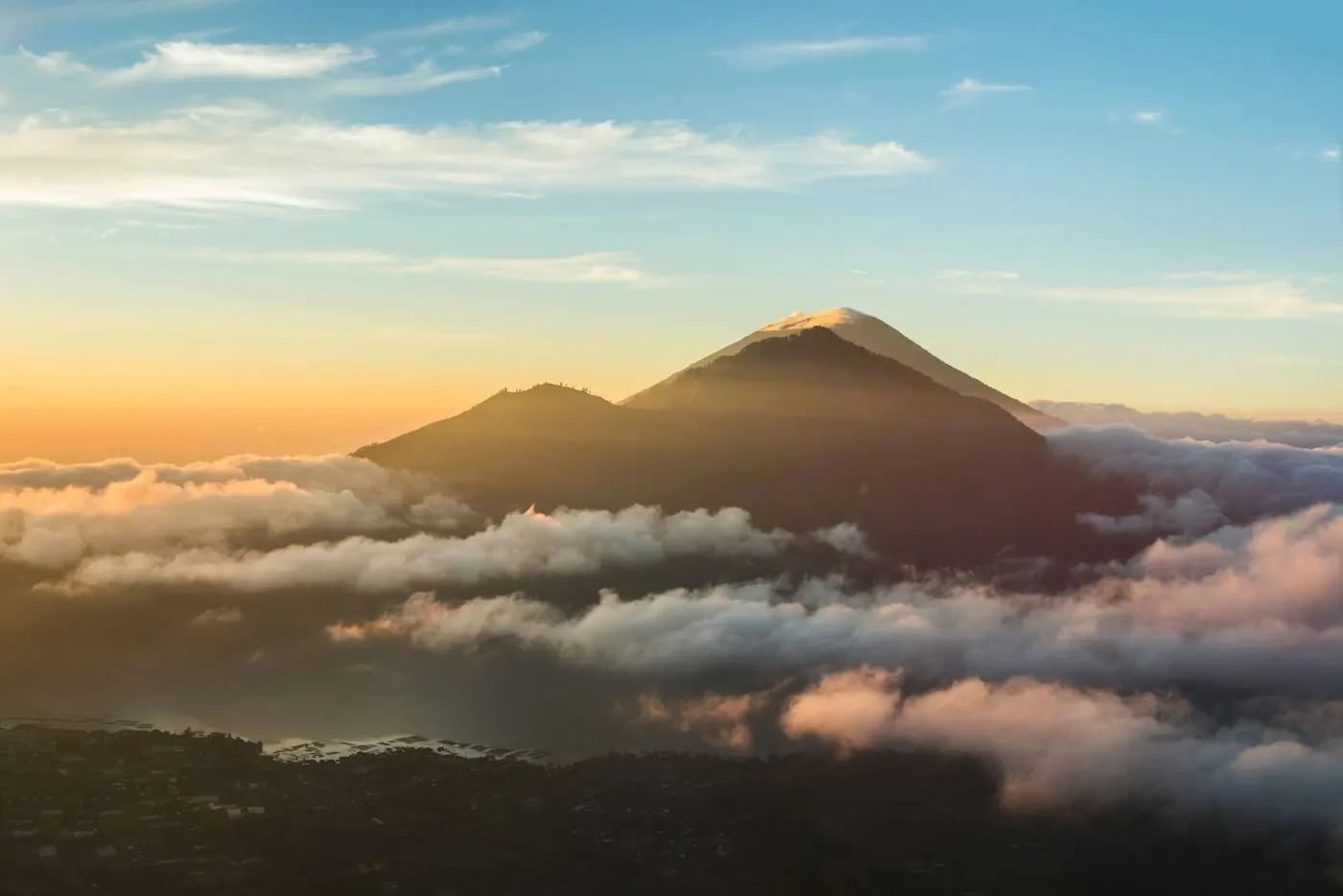
Bali has two volcano hikes that most visitors weigh up, and they are very different days. Mount Batur, in the Kintamani caldera, is a guided sunrise walk that most reasonably fit people can do. Mount Agung, the island’s highest and holiest mountain, is a serious climb that takes most of a night. Both now require a local guide.
Mount Batur: the sunrise walk
Batur rises to about 1,717 metres from the edge of Lake Batur. Treks usually start around 4 a.m. from the villages on the lake shore, reach the top in roughly two hours, and arrive in time to watch the sun come up behind Mount Agung, with Lake Batur below. The path is loose volcanic gravel near the top, so good shoes matter more than fitness.
A registered local guide is required: the Kintamani trekking guides’ association runs checkpoints at the start of the trails, and hikers who arrive without a guide are turned back. Book through your hotel or a tour operator, and ask whether transport from the south, breakfast and a torch are included.
Afterwards, the classic recovery is a soak at Batur Natural Hot Spring in Toya Bungkah on the lake shore, then coffee with the view from the caldera rim at places like Montana Del Cafe or Paperhills.
Mount Agung: the big one
Mount Agung stands at about 3,031 metres and is, for Balinese Hindus, the island’s most sacred place, with Pura Besakih, the Mother Temple, on its slopes. It is a much harder climb: steep, rocky and cold at the top, done through the night to reach the crater rim or summit around dawn.
There are two main routes. The shorter one starts at Pura Pasar Agung on the southern side and ends at the crater rim, below the true summit. The longer route from Besakih climbs to the summit itself and is considerably more demanding. Either way, plan on a very long night and tired legs the next day.
Since January 2025 every climber must hire a local guide. The rule, announced by Bali’s provincial environment and forestry agency, came after a series of deaths and injuries on the mountain, and officials said there would be no exceptions. Climbing is also banned in extreme weather such as heavy rain and storms.
When Agung is closed
Because Agung is sacred, it closes to hikers during major ceremonies at Besakih, and the dates change every year. In 2026 all trekking and other activities on the mountain were stopped for 28 days, from 28 March to 24 April, for the Ida Bhatara Turun Kabeh ceremonies. Before you book, ask your guide whether any ceremony closes the mountain on your dates. Guides will also tell you about local customs: women who are menstruating, for example, are asked not to climb.
Which one should you do?
- Choose Batur if you want a memorable sunrise without a brutal climb, are travelling with teenagers, or have only one free morning.
- Choose Agung if you are a fit, experienced hiker, are happy to start before midnight, and can keep the next day free.
- For both, check the volcano’s current alert level with Indonesia’s volcanology agency (MAGMA Indonesia) before you go. Both are active volcanoes: Agung last erupted between 2017 and 2019.
Sources: The Bali Sun, January 2025 (“Bali announces major changes for tourists who want to climb Mount Agung”), on the provincial circular requiring guides; Travel Trade Journal and Hey Bali News on the 28 March to 24 April 2026 closure; elevations from Wikipedia’s Mount Agung and Mount Batur entries.
Discussion
No posts yet. Been there? Start the discussion with what you’d tell a friend.
Start a new thread
Posts and replies appear after a quick check. No links, phone numbers or promotions. We keep your name and post only; see our privacy note.